Bloggings about what I consume.....and what consumes me.

Monday, November 27, 2006

In Web 2.0 services, Design is the work of Multiple Authors. .. .
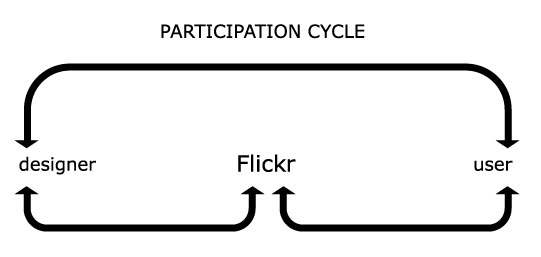
In open-sourced communities as this diagram illustrates, “the order comes from within these communities not from the top” (Leadbeater 5). In such an equal platform, ‘Consumers turn out to be producers as creativity becomes a mass activity not just an elite one.’(Leadbeater 5-6).

In the photo-sharing site Flickr, user participation flows in both directions, where contributions are circulated and re-circulated. In Flickr it its not the photos, but what users do with the photos that puts the mechanism of Design into action. In this user-generated medium, the enrichment of a user experience becomes the primary focus, as our methods of content exposition gives our online activities meaning and purpose.


Summary of findings from Flickr Case Study in Thesis:


Strengths
• There are strong levels of feedback, since all users are in fact contributors.
• Flickr’s open API allows for the development on new features, through the modification of JavaScript.
• Flickr facilitates for creative dialogues between members, where users practices tasks of listening, thinking, and speaking.
• Flickr’s responsive and participatory nature helps to immerse users into their engagement of the service.
• Flickr’s multiple approaches to organization supports greater navigational variations.

Weaknesses
• A folksonomy has a tendency to be ambiguous, as users assign the same tag to different items.
• Users are only granted a finite amount of control of the system, which hinders autonomy and self-expression.
• Users without knowledge of JavaScript can’t make sophisticated modifications.
• Flickr chooses to ignore, rather than devise solutions for members who user Flickr for non-photographic material.

Opportunities
• A folksonomy allow all users to have a “voice” to negotiate the value and meaning of communal content.
• Flickr offers users various choices for archiving, annotating, appropriating and recirculating their generated content.
• Flickr allows users to utilize their content, in and amongst other Web 2.0 services they belong to.
• A designer belonging to Flickr can aim to respond to the challenge of multiple ways that users access information.

Labels: , , , , , ,

Friday, November 24, 2006

Share Your Photos Y'all!!!


As a designer acting a user, it was important to promote the need to be community active (figure 39), as user participation has become the new vehicle for designers to enrich the understanding of Web 2.0 audiences. This should be an objective for any designer acting as a user; this should be the objective for every ordinary Flickr member.

As ‘Interaction is a cyclic process in which two actors(users) alternately listen, think, and speak (Chris Crawford in Shedroff 142), the role of a designer in a user-generated medium is to uphold the conversational and participatory nature of the community. They can achieve this be being community active in their own designated groups (figure 40, 41, 42), and being visible in accumulated community resources.

To view more of my photo-collections, plz follow the link below:
http://www.flickr.com/photos/chasing-sandcastles/

Labels: , , , , , , ,

My procedures for doing Qualitative Research on Web 2.0 services


The steps undertaken to establish an online presence included:

• Creating a user account for a Web 2.0 service

• Generating content within its user page

• Enrolling my accounts into Web 2.0 search databases

• Making informative contributions to the service’s public library so that other users can benefit and can deviate to my user page

• Communicating with other users of the service by offering opinions, joining user groups, and participating in communal discussions.

• Becoming community active by establishing trails to resources of information within the service, and offering links to contacts in other Web 2.0 services.

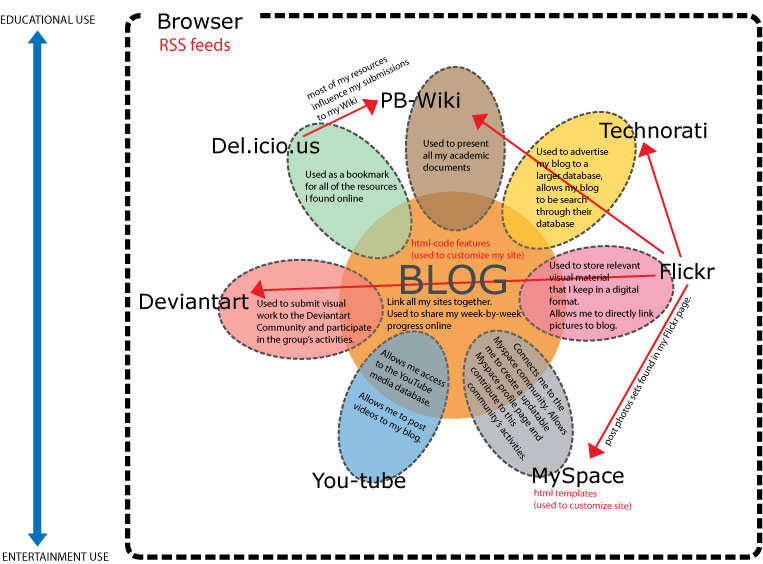
• Promoting a convergent use of Web 2.0 services by interlinking the content amongst my various user accounts.

It was important to establish a sense of connectivity with resources found in various services, as the features of Web 2.0 services promote the circulation and re-circulation of online content. In my qualitative research as a user, it was a goal to create opportunities for open dialogue with other users to as certain emerging user needs, and as a designer, co-develop appropriate design directions through this exchange. In linking my online activities and resources in my various user pages, the probability of this occurring became highly likely.

The main Web 2.0 services I participated in are:
• My Blog (http://www.chasing-sandcastles.blogspot.com/), which is a form of an online diary,

• My Wiki (http://chasing-sandcastles.pbwiki.com/), which are online places where people can easily add and edit content, and are therefore often used for collaborative writing (Kloos 2006 8).

• Flickr (http://www.flickr.com/photos/chasing-sandcastles/) which is a photo-hosting service which manages content through folksonomy

• Del.icio.us (http://del.icio.us/chasing_sandcastles), an online bookmarking service which heavily relies on a user self-tagging system.

• DeviantART (http://chasing-sandcastles.deviantart.com/) Which is a image-hosting service where users upload their art, for critiques and opionions from the DeviantART community.

Labels: , , , , , , , ,